
Quality & Construction
How our buildings are built, materials used, and what sets Amish craftsmanship apart.
View Questions & AnswersQuestions
It means your building is handcrafted by Amish woodworkers in a traditional shop setting. Our buildings come from Homestead Barns, a true Amish shop in the Shipshewana region of Indiana. These aren't factory assembly lines. They're skilled craftsmen building one structure at a time with real attention to detail.
Amish-built means heavier lumber, tighter joints, hand-set components, and a level of pride in the work that comes from a community where craftsmanship is a way of life. It's the same approach they bring to their own homes and barns, applied to the buildings we sell.
Yes. Every building we sell is built by Homestead Barns, a family-owned Amish shop in the Shipshewana region of Indiana. We've worked closely with them for nearly a decade, and the relationship goes beyond business. We're genuinely proud of the friendships we've built with the Amish and Mennonite communities there.
These aren't "Amish-style" buildings from a factory with the label slapped on. They're built by hand in a real Amish shop by people who've been doing this their entire lives.
Good question, and the fact that you're asking it tells you something about the industry. A lot of companies use "Amish-built" as a marketing term when the buildings are actually made in factories with no Amish involvement at all.
Here's what to look for: Ask who the builder is by name. Ask where the shop is located. Ask if you can learn about the people who actually build the structures. A real Amish-built operation will have a specific builder, a specific location, and a real relationship behind it.
Our buildings come from Homestead Barns in the Shipshewana region of Indiana. That's not a label. That's a family-owned shop we've partnered with for nearly a decade. You can see the quality difference the moment you step inside one on our lot.
In our experience, yes. The difference comes down to how they're built and who's building them. Amish craftsmen work with heavier lumber, stronger joints, and a level of precision that comes from generations of building experience. It's not mass-produced. It's handcrafted.
You can feel it when you walk inside one. The floor is solid. The doors hang straight. The framing is tight. Compare that to a big-box store shed that was designed to be cheap, shipped flat in a box, and assembled with a set of instructions. They're not even in the same category.
Does that mean every Amish-built shed is perfect? No. But when you're buying from a reputable builder with a real track record, you're getting a building that's made to last decades, not just survive a few winters.
Everything from the ground up. A big-box store shed is designed to hit a price point. It's built with thinner materials, lighter hardware, and assembled in a factory to be shipped flat and put together with a manual. It's furniture-grade construction pretending to be a building.
An Amish-built shed is constructed as an actual structure. Heavier framing, solid floors, proper roofing, doors that hang true and stay that way. The builders at Homestead Barns, including members of the Yoder family, have deep roots in Amish construction going back generations. That kind of experience doesn't come from an assembly line.
The other difference: big-box stores often nickel-and-dime you on paint, shingles, and extras that should come standard. Our buildings come ready to go with high-gauge metal roofs and quality materials included in the price.
With proper ground prep and basic upkeep, decades. We're talking 20, 30 years or more. These buildings are constructed with the same approach Amish communities use for their own barns and homes, structures that are meant to stand for generations.
The biggest factor in longevity is what the building sits on. Keep it off bare dirt, make sure water drains away from it, and re-stain or touch up paint every few years if you've got a wood exterior. Do that, and your building will outlast most things on your property.
Start with the floor. Walk every inch. It should feel solid and even under your feet with no bounce, no flex, no soft spots. That tells you a lot about the lumber quality and how the joists are spaced.
Next, check the doors. Open and close every one. They should swing smoothly and latch without forcing. Doors that stick or won't close tight are a sign of a frame that's already shifting.
Look at where the walls meet the roof. Tight joints and clean lines mean careful construction. Gaps, daylight, or uneven seams mean corners were cut. Check the hardware too. Hinges, latches, and handles should feel substantial, not flimsy.
Finally, look underneath if you can. The skids and floor joists tell you what the builder really thinks about quality, because that's the part most people never see.
The builder is everything. Two sheds can look identical in a photo and be completely different buildings once you're standing inside them. One might have solid framing, tight joints, and a floor you could park a truck on. The other might start sagging after the first winter.
Who built it determines what lumber they used, how they joined it, how much care went into the details you can't see from the outside. That's why we partner with Homestead Barns. The Yoder family and the rest of the team in that shop have been doing this for a long time, and their reputation runs through Amish building communities across the country.
A shed is never just a shed. It's only as good as the people who built it.
Every building comes with a one-year craftsmanship warranty from Homestead Barns, the Amish shop that builds our structures. That's a top-to-bottom warranty on the workmanship of the building itself. On top of that, the pressure-treated wood used in the floor and structural components carries a lifetime warranty against termite damage and decay. The materials in your building, like LP siding, vinyl, and metal roofing, also carry their own manufacturer warranties.
The one-year craftsmanship warranty covers the build quality of the structure. If something was done wrong during construction, doors not hanging right, framing issues, roof problems, that's what this covers. It's a full top-to-bottom craftsmanship guarantee for the first year.
Beyond that, the pressure-treated wood carries a lifetime warranty against termites and decay. And the individual materials, LP siding, vinyl siding, metal roofing, carry their own manufacturer warranties that extend well beyond the first year.
Normal wear and tear, damage from storms or falling trees, and any modifications you make to the building after delivery. If you add electrical, insulation, or shelving on your own and something goes wrong with those additions, that's outside the warranty scope.
The warranty is about how the building was built, not what happens to it afterward. Take care of it, keep it on a good foundation, and the building will hold up its end of the deal for a long time.
The warranty comes from Homestead Barns, the manufacturer. They build the structures and they stand behind them. If you ever need to make a warranty claim, you'd work with Homestead Barns directly. That said, we're always here to help point you in the right direction if you're not sure where to start.
Give it a thorough look-over when it arrives. If anything looks off, a door that's not sitting right, a panel that's not flush, anything that doesn't meet your expectations, reach out to Homestead Barns directly to start a warranty claim. The one-year craftsmanship warranty exists for exactly this kind of situation.
We also encourage you to contact us. We want to know about it, and we can help make sure you get connected to the right people to get it resolved.
Contact Homestead Barns directly with a description of the issue. They handle all warranty claims on the buildings they construct. Having photos of the problem helps speed things along. If you're not sure how to reach them or what the process looks like, give us a call or text and we'll help you get it sorted.
Yes. The roof is covered under the one-year craftsmanship warranty, so any build-quality issues that show up in that first year are on Homestead Barns to fix. The metal roofing material itself also carries its own manufacturer warranty that covers defects in the material beyond the first year. Our buildings come standard with high-gauge metal roofs built to handle Midwest weather, and they hold up extremely well.
Yes. The floor falls under the one-year craftsmanship warranty for any build-quality issues. Beyond that, the pressure-treated lumber used in the floor and structural base carries a lifetime warranty against termite damage and decay. That Wolmanized treatment is standard on every building we sell.
The best thing you can do for your floor long-term is make sure the building sits on a proper base, gravel, concrete blocks, or a pad, so moisture isn't sitting underneath it. Good ground prep goes a long way.
No, the warranty stays with the original buyer. If you sell your property or the building itself, the warranty doesn't transfer to the new owner. That said, the materials warranties (LP siding, vinyl, metal roofing) may have their own transfer policies depending on the manufacturer, so it's worth checking those individually if the situation comes up.
It depends on what kind of metal shed you're talking about. The thin-gauge metal sheds you see at big-box stores are exactly what most people picture: they dent easily, have no real structure behind the panels, can bend under heavy wind, and don't hold up well in serious weather. Those are a completely different product from what we sell.
Our metal-sided buildings are built on a full wood frame with inner plywood paneling and a high-gauge metal exterior. You're getting the structural strength of a wood-framed building with the durability and weather resistance of quality metal on the outside. Not many builders do it this way, and it makes a real difference in how the building performs long term.
So if you're comparing our metal buildings to a cheap tin shed from a parking lot, they're not even in the same conversation. And if you're choosing between our wood-sided and metal-sided options, both are built on the same quality frame. It comes down to which exterior look and maintenance level fits your preference.
They're different tools. Vinyl siding on a wood-framed building gives you the best of both worlds: the structural strength of wood framing with an exterior that's virtually maintenance-free. No painting, no staining, no rot. It holds up great through rain, snow, and sun year after year.
A painted wood exterior has a more traditional look and gives you more color flexibility, including Sherwin-Williams paint matching. The trade-off is that wood needs occasional maintenance, a fresh coat of paint or stain every several years, to keep it looking sharp and protected.
If low maintenance is your top priority, vinyl is hard to beat. If you want a specific look or color match to your home, painted wood or LP SmartSide gives you more options.
Any of ours, honestly. Our buildings are Amish-built to handle exactly this kind of climate. High-gauge metal roofs for snow load and temperature regulation. Pressure-treated floors and structural components with a lifetime warranty against termites and decay. Quality siding, whether that's painted wood, LP SmartSide, or vinyl, that's built to take whatever Michigan throws at it.
The biggest factor isn't the building itself. It's what it's sitting on. A quality shed on a proper gravel pad or concrete blocks will handle Michigan weather for decades. That same shed sitting on bare dirt is going to have moisture problems eventually, regardless of how well it was built.
Vinyl is the lowest maintenance option. It doesn't need paint, doesn't rot, and cleans up with a hose. For people who want to put up a building and never think about the exterior again, vinyl is the move.
LP SmartSide is an engineered wood product that looks like real wood but resists moisture, rot, and termites better than traditional lumber. It holds paint well and comes with its own manufacturer warranty. Great middle ground between the look of wood and the durability of engineered materials.
Painted wood is the classic choice and gives you the most flexibility on color, including Sherwin-Williams matching. It requires some upkeep every few years, but a well-maintained painted wood shed looks beautiful for a long time.
All three are solid choices. It comes down to how much maintenance you want to do and what look you're going for.
For most people, yes. LP SmartSide gives you the look of real wood with significantly better resistance to moisture, rot, and termites. It's an engineered product designed to outlast traditional lumber siding, and it comes with its own manufacturer warranty.
It holds paint better than raw wood, which means your color lasts longer between touch-ups. And because it resists the things that typically break down wood siding in Michigan's climate, you're spending less time and money on maintenance over the life of the building.
The upfront cost is a bit more than standard painted wood, but most people find it pays for itself in reduced upkeep. If you want the wood look without the wood headaches, LP SmartSide is a smart upgrade.
On a shed, metal wins. Our buildings come standard with high-gauge metal roofs, and there's a good reason for that. Metal handles snow load better, sheds water faster, regulates temperature more effectively, and lasts significantly longer than asphalt shingles. In Michigan, where you're dealing with heavy snow, freeze-thaw cycles, and everything in between, a metal roof just performs better.
Shingle roofs work fine on houses where you've got a steep pitch and regular maintenance. On a shed, metal is the more durable, lower-maintenance choice. It's one of those things that comes standard with our buildings because it's simply the better option for the application.
Vinyl is the lowest maintenance by a wide margin. No painting, no staining, no sealing. Wash it with a hose once or twice a year and you're done.
Urethane-treated wood is a step up from standard painted wood. The urethane finish provides a more durable protective layer that lasts longer between touch-ups, but it's still a wood product that will eventually need attention.
Painted wood looks great but requires the most upkeep. Plan on a fresh coat of paint or stain every few years to keep it protected and looking sharp. The payoff is the most flexibility in color options, including Sherwin-Williams matching.
Bottom line: if maintenance is the deciding factor, go vinyl. If appearance and customization matter more, painted wood or urethane gives you more options with some upkeep involved.
---
Ours can. Our buildings come standard with high-gauge metal roofs and solid framing built to handle real weather. Michigan snow is part of the deal when you live here, and these buildings are designed with that in mind. The Amish builders in the Shipshewana region know Midwest winters just as well as we do.
That said, if you get a particularly brutal stretch and snow is piling up several feet deep on the roof, it's not a bad idea to knock some of it off. That's good practice for any structure, including your house. But under normal Michigan winter conditions, your building will handle it just fine.
Our metal roofs are built to handle typical Midwest snow loads without any issues. The steeper roof pitches on styles like lofted barns and gambrel roofs naturally shed snow faster, which helps prevent heavy accumulation.
For most Michigan winters, you won't need to do anything. If we get one of those stretches where it just keeps dumping and the snow is packing several feet deep, clearing some off the roof is a smart move. But that's true of any building, not just ours.
For most residential properties, the weight of the building itself keeps it in place. Our buildings are solid, heavy structures, not lightweight kits that catch wind like a sail.
That said, anchoring is a smart addition in certain situations: wide-open properties with no windbreak, elevated or exposed lots, or if your local township requires it. We offer anchoring options, and if you're not sure whether your property calls for it, give us a call or text. We'd rather help you plan for it upfront than deal with a problem later.
Freeze-thaw is one of the biggest reasons ground prep matters. When the ground freezes and thaws repeatedly through a Michigan winter, it expands and contracts. If your building is sitting directly on bare dirt, that movement can shift the structure over time, leading to uneven floors, doors that stick, or gaps forming where they shouldn't be.
The fix is simple: put your building on a proper base. A gravel pad is the most common and cost-effective option. It drains well, stays stable through temperature swings, and gives the building a solid, level surface to sit on. Concrete blocks or a poured pad work too. The key is keeping the building off the bare ground so freeze-thaw doesn't work against you.
Not necessarily. We deliver year-round, and plenty of customers take delivery in the colder months. The building itself doesn't care what temperature it is when it arrives.
The main consideration is your site. If the ground is frozen solid, that can actually make delivery easier in some cases since the ground is firm and won't rut up. Where it gets tricky is heavy snow cover that makes it hard to access your property or position the building accurately. If you're planning a winter delivery, just make sure the path to your site is accessible and reasonably cleared. Give us a call or text and we can help you figure out whether timing works for your situation.
They can. Michigan has seasonal weight restrictions on certain roads, typically in the spring when the ground is thawing and roads are most vulnerable. During those windows, some roads have load limits that could affect delivery routes depending on where you're located.
This isn't something most customers need to worry about, but if you're in a rural area with seasonal roads, it's worth mentioning when you call to schedule delivery. Our team knows the drill and can help plan around any restrictions to make sure your building gets there without issues.
A gravel pad is the gold standard for most portable buildings. It drains well, stays stable through freeze-thaw cycles, and provides a level, solid surface that won't shift with the seasons. It's also the most cost-effective serious foundation option.
If a gravel pad isn't in the budget, concrete blocks are a fantastic alternative. A lot of our customers pick up 10 to 15 affordable concrete blocks from Lowe's, Home Depot, or Menards and have them on-site when the building arrives. Our delivery driver will place them for you, giving your building a balanced, elevated base that keeps it off the ground and draining properly. It's one of the cheapest upgrades you can make, and it goes a long way.
A poured concrete pad is the most permanent option and makes the most sense for larger garages or buildings you plan to keep in one spot for decades.
The one thing to avoid is setting your building directly on bare dirt. Moisture, frost heave, and poor drainage will cause problems over time no matter how well the building is constructed. A little ground prep protects the whole investment.
Our sheds are hand-built by Amish craftsmen in Northern Indiana and Southern Michigan, with real 2×4 framing, 3/4" tongue-and-groove flooring, and LP SmartSide siding instead of thin panels and particleboard. They're built to stand for decades, not a few seasons, and they arrive finished and ready to use. The material warranties behind them speak to that longevity.
Ours are hand-built by Amish craftsmen with real framing, composite flooring, and finish details meant to last outdoors for years. They arrive as a finished structure and set in place, instead of a kit you assemble over a weekend. The quality shows in how they hold up season after season.
Ours don't. The metal siding on our buildings is 29-gauge Galvalume-coated steel, a finish designed to go the life of the building without rusting or needing paint. That is a different material class from the thin bare-steel panels on big-box kit sheds, which can start corroding at the cut edges within a few seasons.
Under the steel is the same full wood frame and inner plywood paneling as every building we sell, so the metal is a skin, not the structure. If a panel ever takes damage from an impact, it can be replaced without touching the frame.
Less than most people expect. The Galvalume steel exterior reflects heat rather than absorbing it, which reduces interior temperature buildup during Michigan summers. A metal-sided building generally runs cooler on an August afternoon than a dark-shingled one.
Airflow matters more than the siding material. Windows and vents are available options on every style that comes in metal, and placing the building where it catches some shade makes a bigger difference than the choice of exterior.
More Questions
Back to FAQ
Buying & Getting Started
Everything you need to know before purchasing an Amish-built building.
20 Questions
Rent-to-Own & Financing
Payment options, rent-to-own details, and financing for your building.
35 Questions
Pricing & Value
What things cost, what affects price, and how to get the best value.
20 QuestionsSee Yours Before
You Buy It
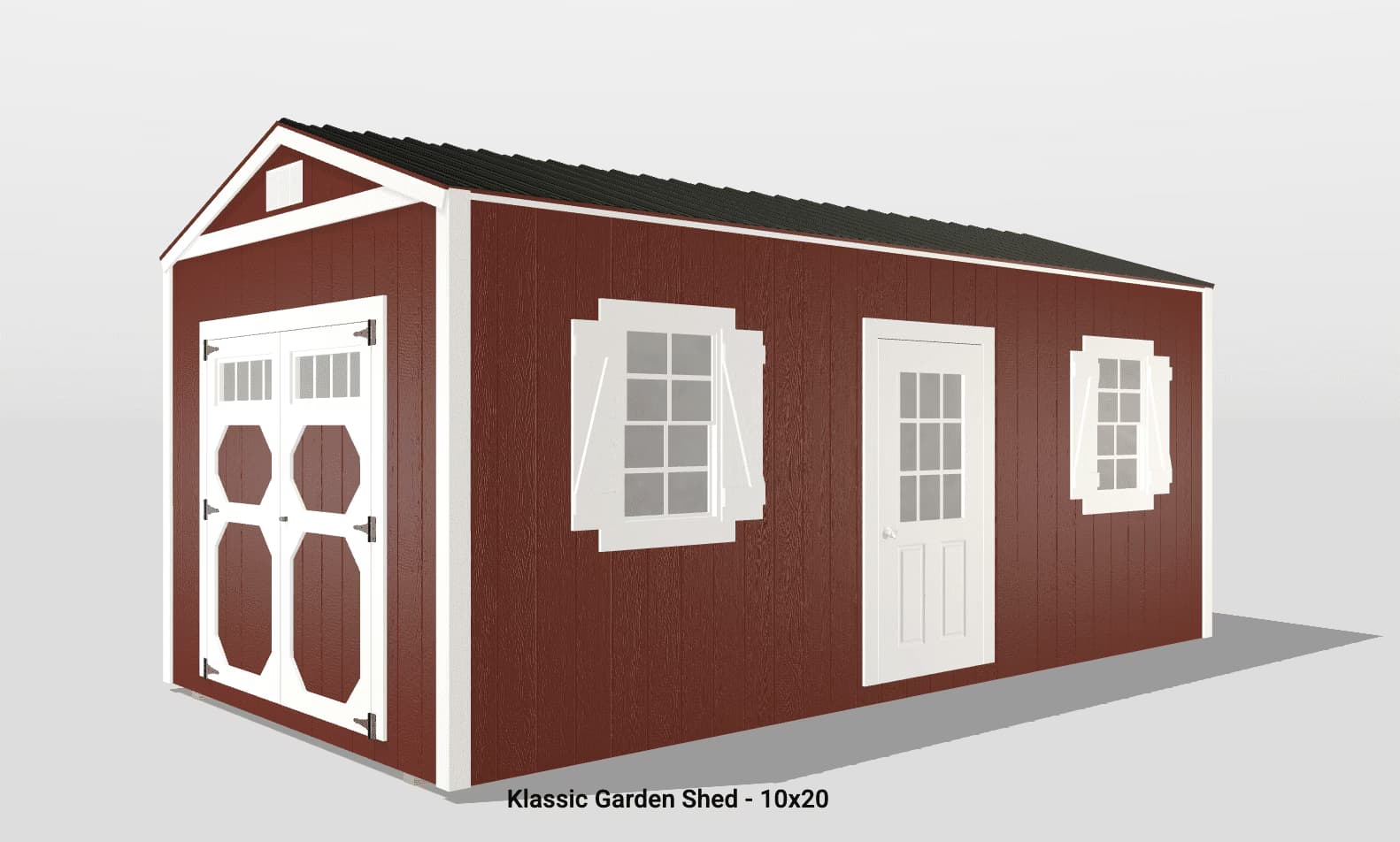
Pick your style, size, colors, and options. Rotate it, zoom in, and make it yours. The whole process is easy and you'll walk away knowing exactly what your building looks like before you commit.
Walk Through the Buildings.
Open Every Door.
Adrian
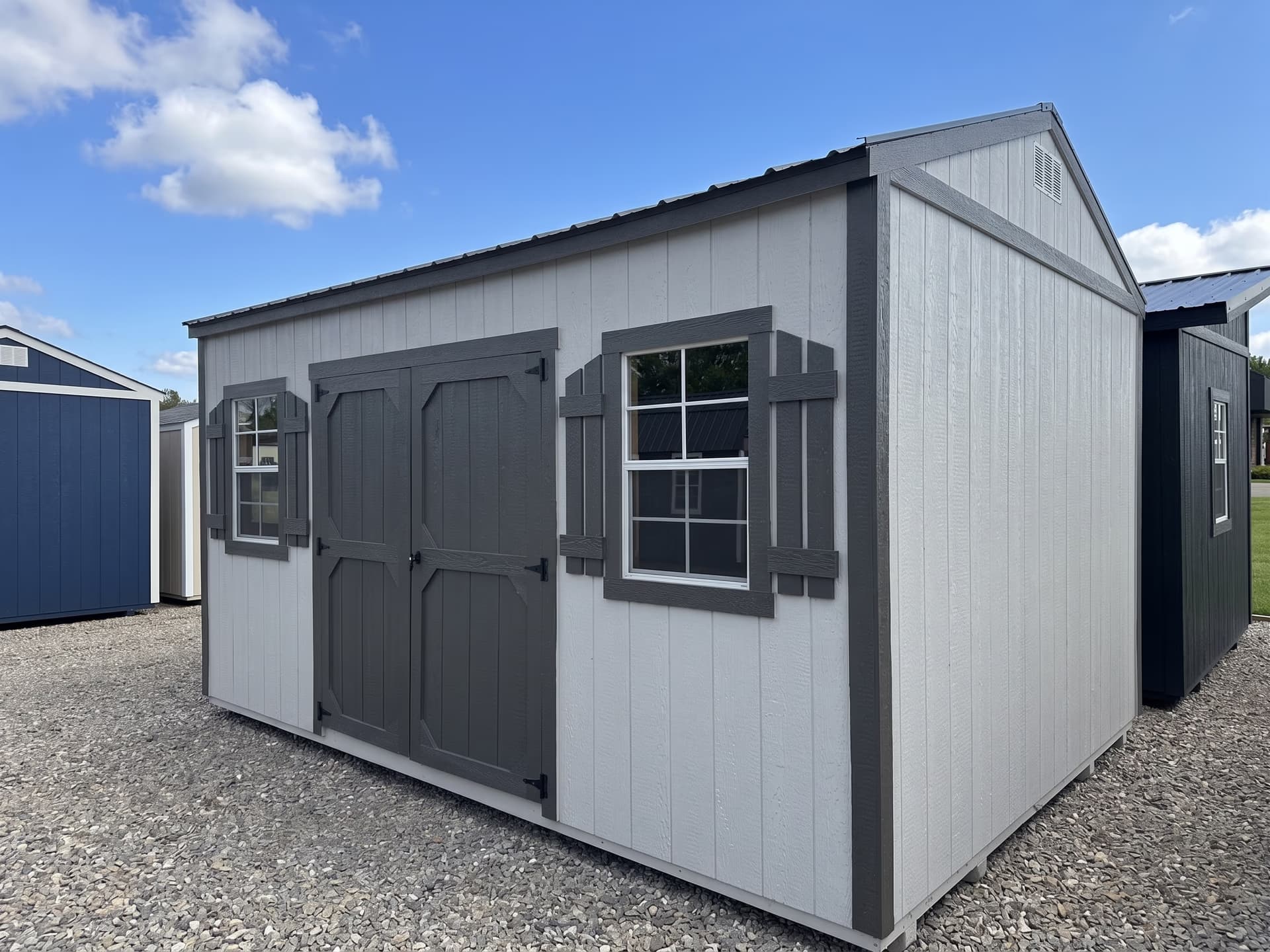
Our first established location just off US-223 in Adrian. Walk through dozens of styles and configurations, sit inside a few, take your time. No appointment needed. We leave the buildings unlocked. Come see the quality for yourself.
Hours
Mon–Tue: 10am–5pm
Wed: Closed
Thu–Fri: 10am–5pm
Sat: 10am–3pm
Sun: Closed
Carleton
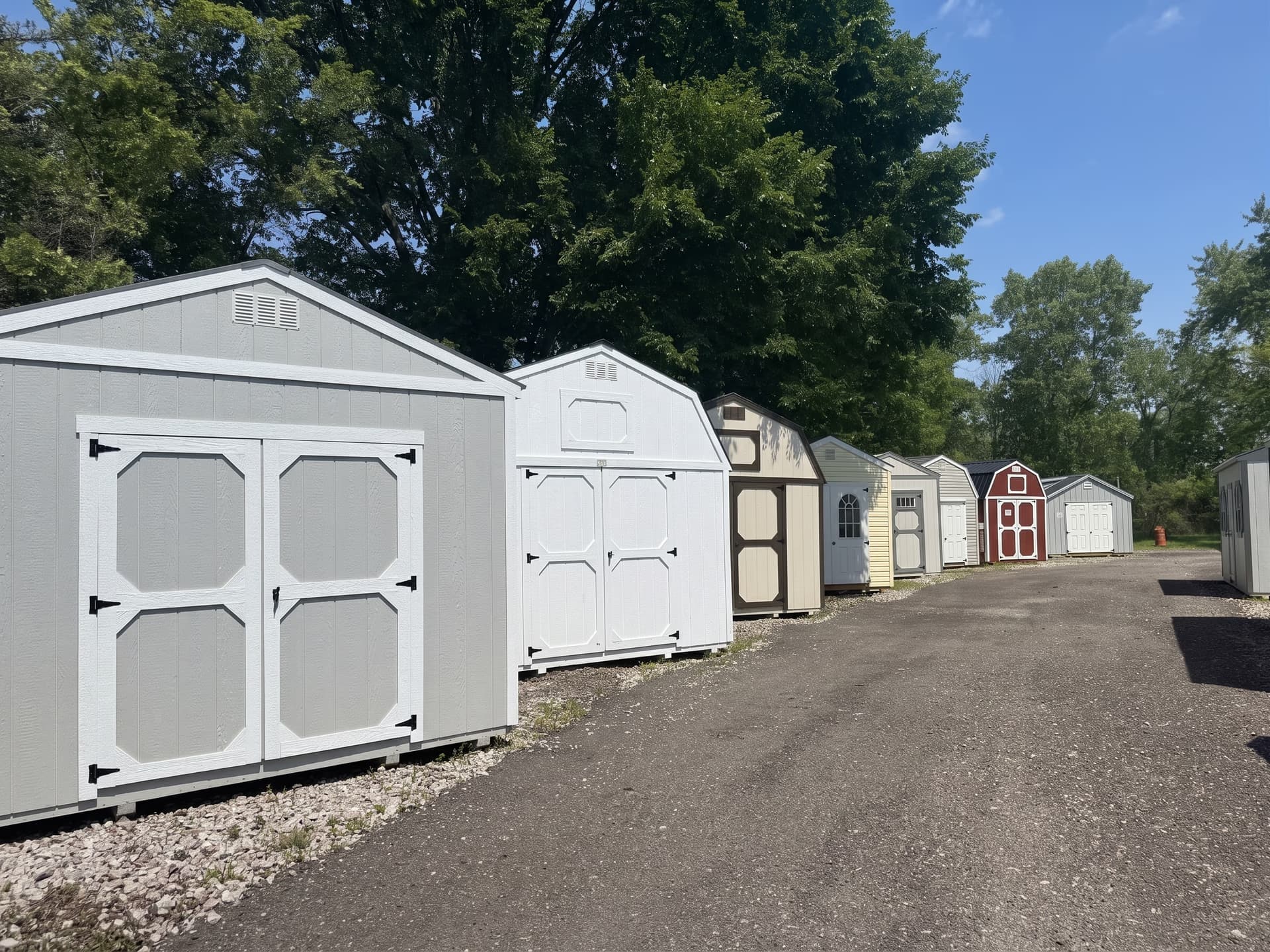
Located just off Telegraph Road in Carleton, we have a full selection of sheds, cabins, garages, barns, and more ready to walk through whenever you're ready. We can't wait to see you soon.
Hours
Mon–Tue: 10am–5pm
Wed: Closed
Thu–Fri: 10am–5pm
Sat: 10am–3pm
Sun: Closed